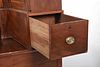

Sideboard with China Press
Mahogany and mahogany veneers
Charleston, South Carolina
Attributed to the shop of Robert Walker (1772-1833)
Recorded by MESDA as MK – 5453 NC – 71 Furniture of Charleston 1680-1820
Circa 1795-1805
87” H 75” W 28” D
in the last decades of the 18th century, sideboards as we know them today, with drawers and cabinets for storage evolved from the “slabs” or “sideboard tables” of mid-century. This grand Charleston sideboard represents a boldly handsome interpretation by Robert Walker, one of the city’s foremost cabinetmaker, of the new furniture form. In its scale and enormous storage capacity the design and proportions were exceptionally well suited to Charleston’s elegant, large homes. This sideboard was first recorded in the files of Milby Burton, Director of the Charleston Museum from 1932 until 1972. Bivins and Rauschenberg attribute it to in their authoritative and comprehensive Furniture of Charleston attributed the press and sideboard to the Walker shop based on its similarities to three labeled or signed pieces and five attributed pieces of Walker furniture. Recorded by MESDA as MK – 5453 & NC–71,Furniture of Char
Robert Walker (W. 1797-1833) was born and (probably) trained in Scotland before relocating to New York circa 1793. After a brief stay there he moved to Charleston and advertised his presence as early as 1795. Walker quickly established himself as among Charleston’s premier cabinetmakers and by all indications ran a large and successful shop. As evidenced by numerous court, business and civic records, Walker was involved in a range of mercantile ventures beyond his cabinet shop including real estate. His advertisements noted the types of merchandise available on hand and by order with sideboards prominently featured among the furniture Walker offered. The documentation of Walker’s life and career in Charleston is extensive and largely recorded in the 18 pages devoted to his activities in the Furniture of Charleston, pages 1255-1272, and the numerous catalogue entries pertaining to specific pieces of his furniture. Bivins and Rauschenberg describe Walker as “one of the most successful Charleston cabinetmakers of his time”, a conclusion well supported by this sideboard and other surviving works by this important and prominent craftsman.
Condition: The sideboard retains its structural integrity with minimal, minor repairs consistent with its age and use. The secondary woods are principally yellow pine and poplar, The upper case is flanked by drawers that extend outward from each side. The center arch is formed by the fashionable “French” style pillars which link the serpentine lower case with the breakfront upper case. The four paneled doors of excellent mahogany. The form and construction of the lower case are consistent with other contemporary labeled, signed and Walker attributed sideboards recorded by MESDA. The breakfront upper case is completed by a crossbanded frieze and dentiled pediment. Characteristically of Walker cases for presses and cupboards, the upper case is constructed of framed paneled boards which allow expansion and contraction with extremes of humidity.